
ADS is not a village. It is Oregon’s sovereign creative‑technology industry — a fusion of cinematic production, architectural innovation, and next‑generation research designed to generate billions in economic activity over the coming decades.
But ADS is also something more:a continuity engine. Every dollar spent inside this Art‑Tech Village activates a multiplier effect that ripples outward through Oregon’s economy — strengthening local businesses, expanding regional supply chains, increasing household income, and generating new civic revenue. What economists describe as direct, indirect, and induced spending becomes, inside ADS, a governed flow of continuity: creativity igniting commerce, commerce stabilizing community, and community reinforcing sovereignty.
Modularity is adaptability. Where and when the whole is greater than the sum of its parts, all points on the sphere are aimed at the center.
Aligned with the LuM3nUs substrate, the M3RLYN OS, the Auteur Suite, and the broader M3 ecosystem (M3M, M3REIT, M3GALAXY, and future divisions), ADS forms a vertically integrated engine of production, technology development, intellectual property, manufacturing, and exportable creative‑tech systems. This is the industry California never imagined — and the one Oregon is uniquely positioned to lead.
At its core stands Studio C, the Castle Stage — a 250,000‑square‑foot programmable cinematic environment whose walls function not as painted surfaces, but as technological substrates. These modular emissive fields can shift between blue‑screen and green‑screen modes in independently controlled zones, enabling multiple productions to operate simultaneously while serving as the R&D crucible for the photonic‑filament projection systems that will define the Brilliant Era of filmmaking.
ADS is where the controlled shadows of classic noir meet the mythic futurism of the 21st century — where the cinematic past and the technological future converge into a single, sovereign industry. It is the institutional foundation of Oregon’s Brilliant Era, the moment when the state rises from #25 into the top ten economic engines in America.Not through imitation.Not through chance.But through the creation of a new industry that no investor, no banker, and no institution can ignore.
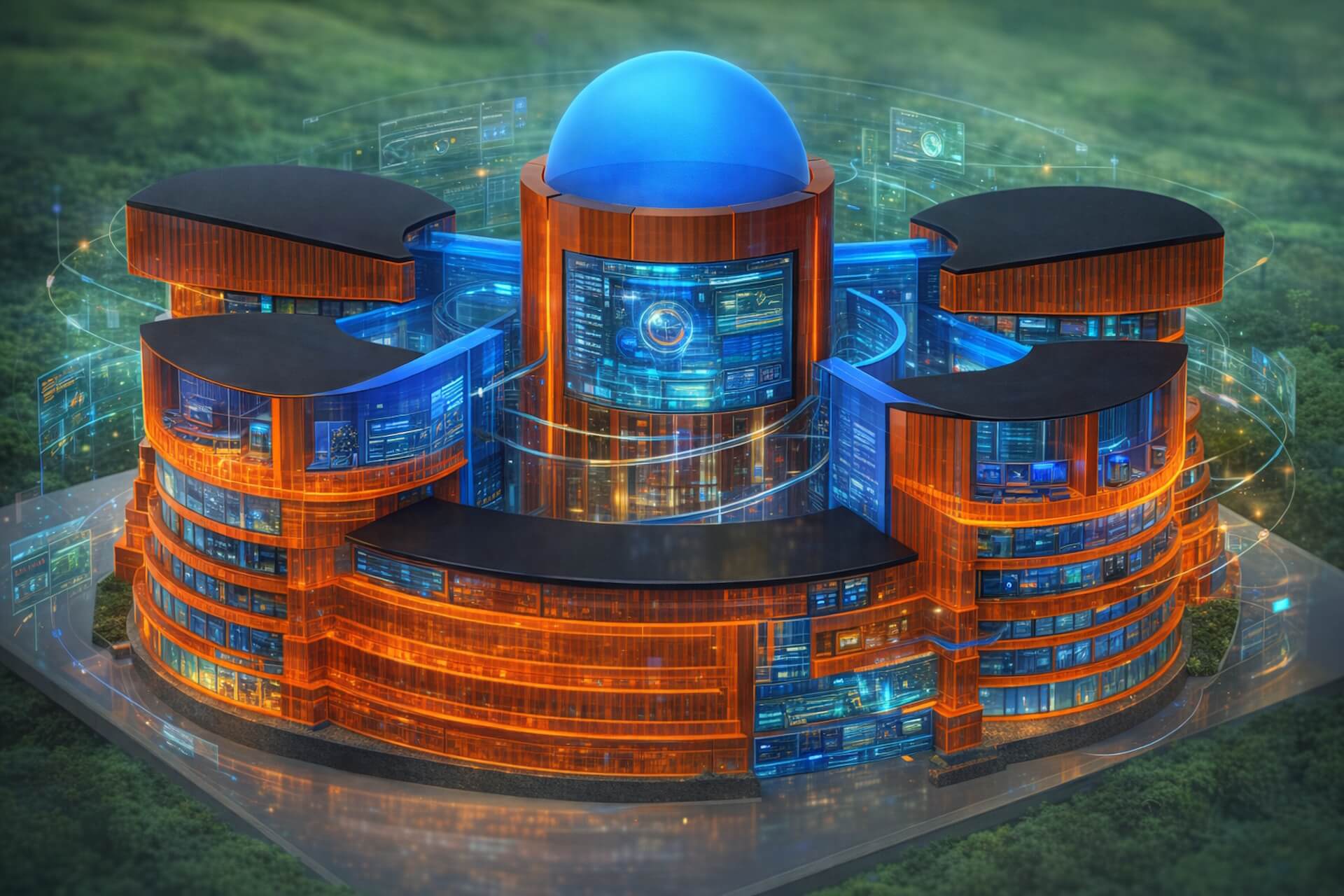
The M3 ADS — Avalon Digital Studios — Art‑Tech Village is anchored by four monumental Titans and supported by two essential Pillars. Together, they form the structural, creative, and operational foundation of this precedent‑setting model of leadership‑by‑example.
The image above is only a preliminary glimpse of the ADS vision. Today’s CGI tools cannot yet express the full botanical, architectural, and regenerative complexity — which is precisely why the M3 Auteur Suite is being built. What you see here is a starting point, an early sketch of the most fundamental elements. What you do not see are the equally scaled structures below ground — the subterranean tech‑stack vaults and the Jeffries Tubes that bind them together into a single, substrate‑powered system.
At the center stands the M3 ADS Arthur C. Clarke R&D Center — the research braintrust of the village, where next‑generation regenerative systems are architected atop the LuM3nUs substrate — where next‑generation regenerative concepts of the Brilliant Era will be developed. Beside it, overlooking the river, rises the M3 ADS Photonic Dome, the auric lifeblood and primary showcase of the entire Art‑Tech ecosystem.
To the north, the M3 ADS Studio C emerges with its cinematic castle façade — both camouflage and landmark. To the west, the M3 ADS Monastery — the Pillar of Memory — anchors the future archive and sonic identity of the village. And to the south, the M3 ADS SkyChurch forms the communal heart — the Pillar of Gathering and long‑arc imagination.
All of it is expressed in a unified architectural language of orange‑red cedar and purple‑grey granite, shaped in the timeless form of agricultural Monitor Barns — a blend of past and future, craft and technology. Together, they form a regenerative, self‑contained, pedestrian village built as a front porch to the future and the first step of the New Oregon Trail into the 22nd century.
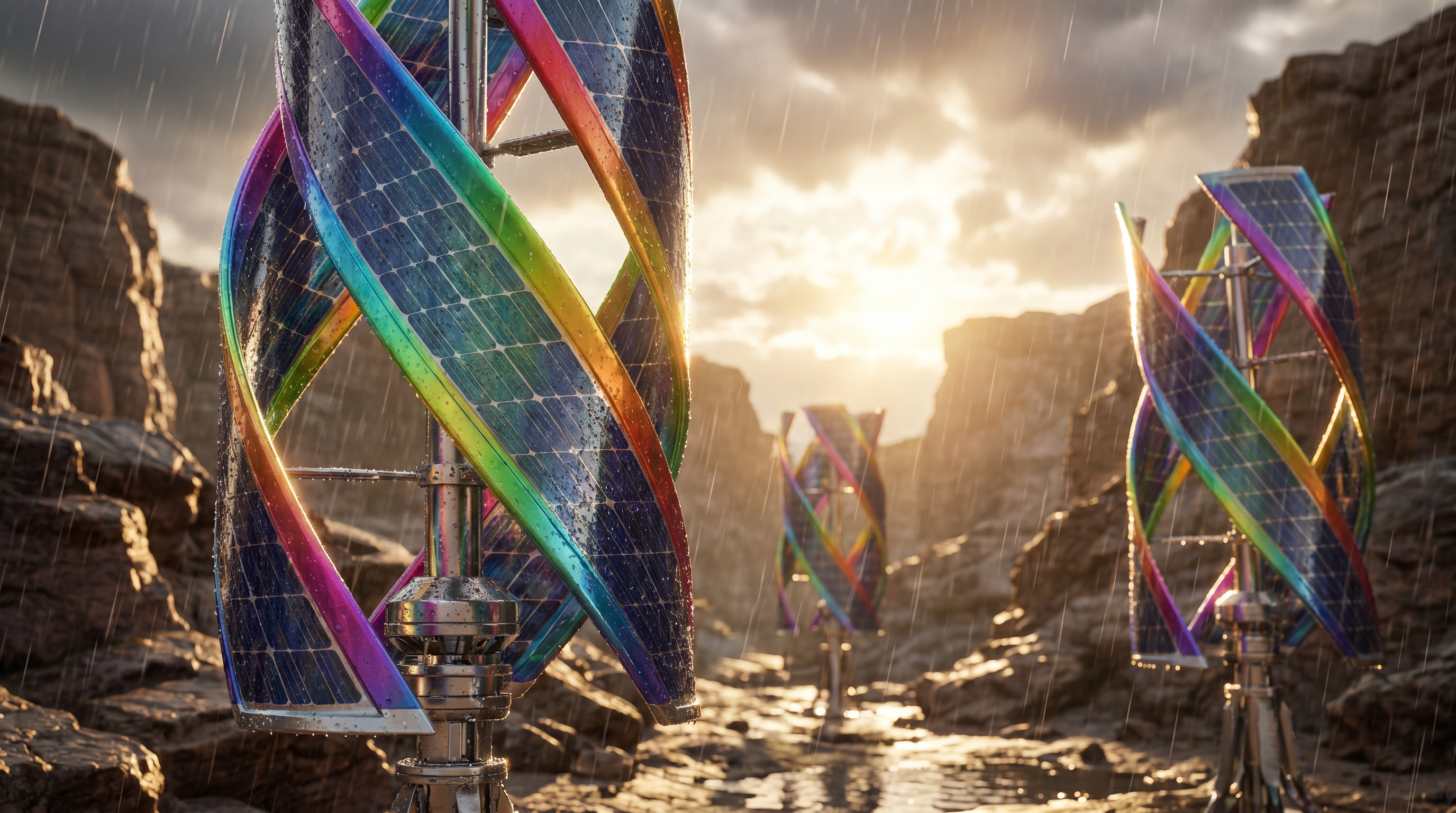
Along the pedestrian paths of ADS rise the Hybrid Energy Spires — vertical regenerative organs that embody the village’s core principle:every surface participates. These are not wind turbines, and not solar panels. They are multi‑input energy instruments that harvest power from the environment in all its forms.
Each spire integrates five complementary energy pathways:
• solar membranes that drink light across the full day
• vertical‑axis wind rotors that breathe the canyon’s micro‑gusts
• triboelectric rain‑harvesting surfaces that convert rainfall into charge
• micro‑delta Stirling engines that metabolize heat differentials
• kinetic flutter elements that capture ambient motion
Instead of losing performance in storms, winter, or cloud cover, the spires become more active — turning weather into a resource rather than a disruption. Rain accelerates the rotors. Cold amplifies the Stirling cycle. Impact generates charge. Variability becomes stability.
This is the ADS energy doctrine:
resilience through hybridity, continuity through motion, sovereignty through design.
The spires are not merely infrastructure.
They are ceremonial instruments — lining the walkways like kinetic banners,animating the land with rhythm, color, and quiet motion. They express the identity of the village as a substrate‑powered system, where technology is integrated, not imposed; regenerative, not extractive; beautiful, not industrial.
In the Brilliant Era, energy is not a commodity.
It is an architectural language.
The Hybrid Energy Spires are its first grammar.
ADS is a pedestrian village, but it is not isolated.
Its connective tissue is the ADS MagLev — a silent, elevated, weather‑positive mobility system powered by the same hybrid energy architecture that animates the village itself.
The MagLev is not a train.
It is a circulatory organ.
Its guideway, and the cars themselves, are wrapped with the same five‑input hybrid membranes that power the M3 ADS HYBRID ENERGY SPIRES:
solar, wind, rain, heat differentials, and ambient motion.
Every meter of track is an energy‑harvesting surface.
Every column is a micro‑generator.
Every passing vehicle becomes part of the energy cycle, feeding the system that moves it.
In storms, the MagLev becomes more efficient.
In winter, it stabilizes.
In Oregon’s shifting microclimates, it thrives.
This is mobility in the Brilliant Era —
not a vehicle imposed on the land,
but a regenerative organ integrated with it.
The ADS MagLev connects the Titans, the Pillars, the Dome,and the Clarke R&D Center into a single, continuous system — and in the future, it will extend outward to the farming communities that anchor the next phase of Oregon’s sovereign creative‑tech economy.
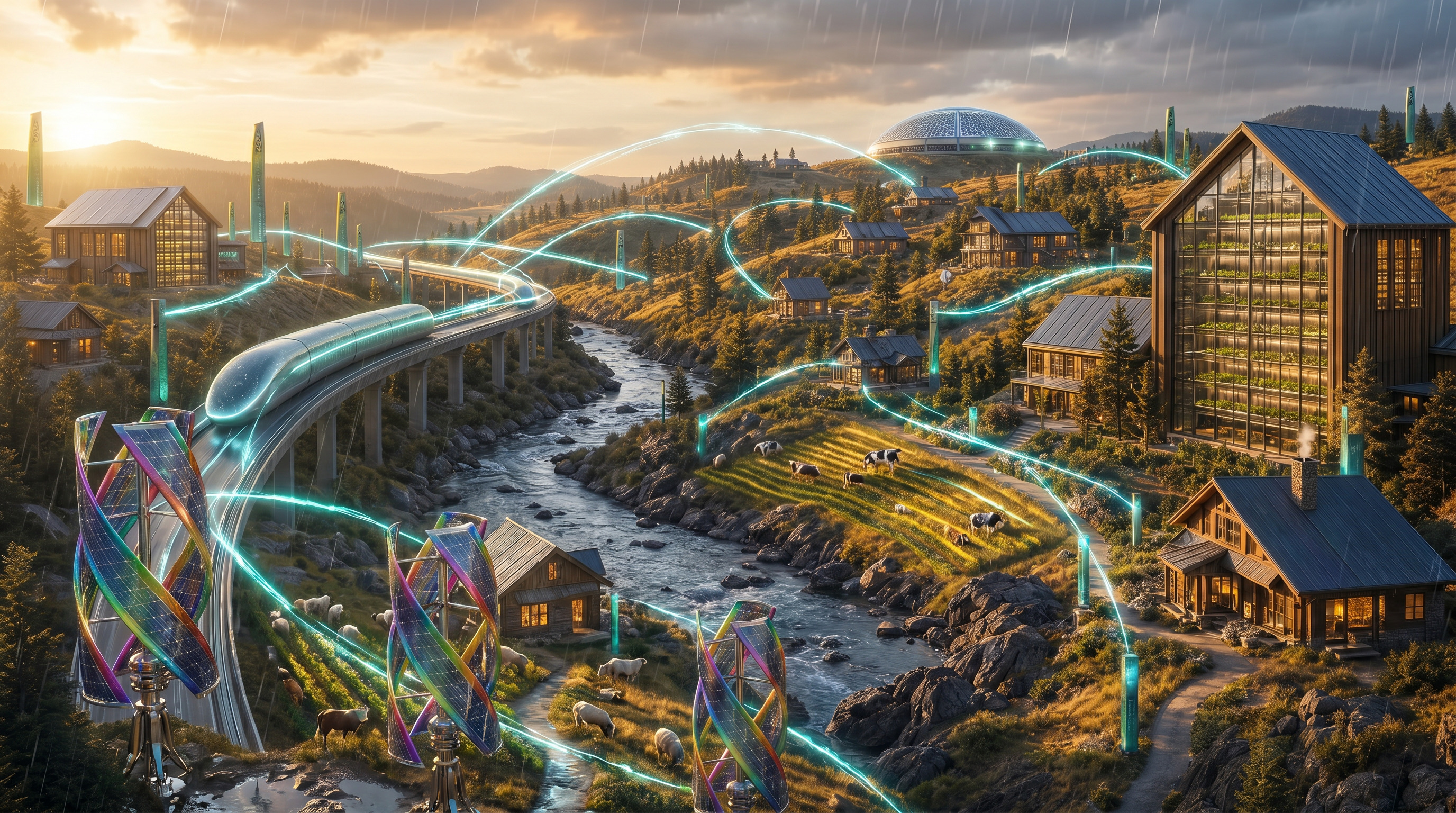
ADS is not the end of the story. It is a new beginning.
It is the prototype for a broader transformation of Oregon’s rural landscape —a network of Brilliant Era farming communities designed to feed the region more efficiently, more sustainably, and more beautifully than any industrial system of the past century.
These communities combine:
• automated vertical aerofarms that grow year‑round with 90%less water
• brilliant homes powered by hybrid energy membranes
• closed‑loop water systems that recycle, condense, and regenerate
• local micro‑grids stabilized by sodium‑ion and molten‑salt storage
• soil‑restoration corridors that heal the land while producing food
• MagLev‑connected logistics that move produce without diesel or delay
This is not a return to agriculture.
It is the reinvention of it.
A 22nd‑century farming model where:
• food is grown vertically, not horizontally
• homes generate more energy than they consume
• water cycles are closed, not extractive
• and rural communities become centers of innovation, not afterthoughts
These farming villages will feed the region, stabilize the grid, and form the economic buffer around ADS — a constellation of regenerative settlements that extend the Brilliant Era beyond the studio and into the land itself.
ADS is the prototype.
The farming communities are the expansion.
Together, they form Oregon’s sovereign creative‑tech civilization.
We now have the foundational elements of a system that has been out of reach for decades: subterranean fusion nodes, SS‑H2 seawater hydrogen production, salt‑based energy storage, and closed‑loop hydrological regeneration. Each is powerful alone; together they form a single architectural organism in which every part feeds, cools, and sustains the others.
At the coastline, a Fusion Core provides continuous,high‑density energy. Its thermal output is not treated as waste, but as a primary design feature. A closed‑loop cooling architecture routes fusion heat through subterranean exchangers that drive high‑efficiency turbines and heat‑to‑power cycles, converting what would have been discarded thermal energy into additional electricity. The same cooling network stabilizes the underground environment, creating a thermally consistent envelope for the rest of the system.
Adjacent to this, the SS‑H2 Hydrogen Organ uses fusion power to split seawater directly — something previously uneconomic at scale. SS‑H2’s dual‑passivation stainless steel survives the full electrochemical window of seawater splitting, collapsing materials cost and unlocking industrial‑scale hydrogen production from the ocean itself. This process produces hydrogen, water vapor, and salt. In the Brilliant Era system, all three are resources.
Water vapor is condensed into freshwater, routed inland to recharge aquifers, restore rivers, and support agriculture. The extracted salt becomes feedstock for sodium‑ion and molten‑salt batteries,enabling abundant, domestically sourced grid‑scale storage. Hydrogen serves as both an energy carrier and an industrial feedstock, integrating with fuel cells, process heat, and exportable energy systems. Fusion → cooling → heat‑to‑power→ hydrogen → freshwater → sodium batteries: a closed‑loop coastal node where every output is an input to another organ.
All of this lives in subterranean reinforced chambers,beneath the Oregon coastline, where geological stability, thermal inertia, and environmental isolation create a century‑scale operating environment. These caverns take years to excavate and fortify — which is why the groundwork must begin now. The physics barriers have fallen. The materials exist. The thermodynamic pathways are understood. What remains is the architectural assemblage: designing the system so that every component supports the others as a coherent whole.
Within ADS, this is the kind of work that orients the Arthur C. Clarke R&D Center: not isolated inventions, but integrated organs built atop the LuM3nUs substrate — the architectural spine of the Brilliant Era.
The Brilliant Era coastal node is architecture in the deepest sense — energy, water, materials, and geology composed into a single substrate‑powered system.
The system is ready in principle.
The chambers will take years.
The architecture must begin now.
If you’d like to explore the broader ecosystem we’re building, you can engage with us on many levels — including through our public presence on Wefunder.